Professional Custom Enterprise Application Development Services
Need a custom enterprise application? BMS Services provides integrated ERP, CRM, operational dashboards, and business automation tailored to your needs.
Custom Enterprise Application Development Services for Modern Businesses
Digital transformation has become one of the most important factors in the growth of modern businesses. Companies that still rely on manual processes typically begin to face various challenges as operations become increasingly complex. These challenges range from unintegrated data, slow approval processes, difficult business monitoring, to recurring human errors.
Therefore, the use of enterprise applications is no longer just an additional need, but has become an important foundation in modern business operations.
BMS Services Indonesia provides custom enterprise application development services specially designed to match business workflows and operational needs. The system is developed to enable companies to work more efficiently, be integrated, scalable, and ready to face long-term business growth.
What is an Enterprise Application?

An enterprise application is software or a digital system used to help internal business operations become more automated, structured, and easy to monitor.
Unlike general software, custom enterprise applications are usually built based on specific company workflows, ensuring the system is highly relevant to daily operational needs.
Enterprise applications can include:
Enterprise ERP
Customer CRM
Inventory management
Operations dashboard
HR management
Purchasing system
Approval workflow
Finance system
Project management
Sales monitoring
Customer portal
Business intelligence dashboard
The primary goal of enterprise applications is to improve operational efficiency and reduce reliance on manual processes.
Why Do Modern Businesses Need Custom Applications?
Many companies initially use spreadsheets, WhatsApp, email, and separate software to run business operations.
However, as companies grow, these methods start to create various problems such as:
Unsynchronized data across divisions
Many repetitive manual processes
High human error rate
Slow approvals
Difficult business performance monitoring
Time-consuming reporting
Data scattered across many platforms
Inefficient communication between teams
Difficulty scaling operations
These problems can hinder business growth if not resolved promptly.
For this reason, many companies are starting to build custom enterprise applications that are integrated with all business operations.
Differences Between General Software and Custom Enterprise Applications
Many businesses use off-the-shelf software because it is faster to implement. However, in the long run, general software often has limitations.
General Software
Generic features
Limited workflows
Difficult to customize
Limited integration
Must follow the software's system
Custom Enterprise Applications
Built according to business workflows
Flexible for development
Easy to integrate
More scalable
Can accommodate company growth
Therefore, custom software is usually more suitable for companies with complex business processes or those looking to build a long-term system.
Benefits of Using Enterprise Applications
The implementation of enterprise applications significantly impacts business efficiency.
1. Operational Automation
Many administrative tasks can be automated, such as:
Automatic approvals
Automatic reminders
Automatic reporting
Automatic lead distribution
Real-time monitoring
This helps reduce repetitive manual work.
2. Reduce Human Error
Human errors often occur in manual processes, such as:
Incorrect data entry
Incorrect report calculations
Duplicate data
Communication errors
With digital systems, validation and automation help reduce the risk of errors.
3. Real-Time Business Monitoring
Management can monitor the company's status directly through dashboards.
Monitored data includes:
Sales
Inventory
Finance
Team productivity
Company KPIs
Project progress
Customer activity
4. Increase Team Productivity
Teams can work faster because:
Data is easier to access
Workflows are clearer
Communication is more structured
Many processes run automatically
5. Facilitates Decision Making
Accurate business data helps management make decisions based on real-time data, not assumptions.
Commonly Used Enterprise Application Types

BMS Services Indonesia helps companies build various types of business applications according to operational needs.
ERP (Enterprise Resource Planning)
ERP helps integrate all company operations within a single system.
ERP modules typically include:
Finance
Inventory
Purchasing
HR
Sales
Warehouse
Production
ERP helps all divisions work using the same data.
CRM (Customer Relationship Management)
CRM helps companies manage customer relationships and sales activities.
CRM features:
Lead management
Sales pipeline
Follow-up automation
Customer database
Activity tracking
Sales reporting
HR Management System
Helps manage HR functions such as:
Attendance
Payroll
Recruitment
Leave management
KPI monitoring
Inventory Management System
Helps monitor stock levels and warehouse operations in real-time.
Project Management System
Used for monitoring work progress and team collaboration.
Finance & Accounting System
Helps manage company finances and reports.
Business Websites as Operational System Frontends
In the modern digital era, company websites are no longer just company profiles.
Websites can now serve as frontends for various business operational systems such as:
CRM
ERP
Inventory system
Customer portal
AI automation
Dashboard monitoring
Booking system
Helpdesk system
At BMS Services Indonesia, business website development is focused on direct integration with the company's operational systems.
With this approach, the website becomes a digital interaction hub connecting customers, internal teams, business data, and workflow automation within a single integrated ecosystem.
Case Study: Distribution Company Reduces Manual Processes by 80%
One of BMS Services Indonesia's clients is a distribution company with quite complex operations.
Before digitalization, the company used:
Manual spreadsheets
WhatsApp for approvals
Repetitive data entry
Manual reporting
Separate sales monitoring
This resulted in various problems:
Unsynchronized data
High human error
Slow approvals
Time-consuming reporting
Difficulty monitoring sales performance
Numerous repetitive administrative tasks
Solution Built
BMS Services built a custom enterprise application that includes:
Operational dashboard
Sales monitoring
Digital approval workflow
Inventory integration
Customer CRM
Automated reporting
Multi-user roles
Mobile responsive system
Results After Implementation
After system implementation:
Manual processes reduced by up to 80%
Significant reduction in human error
Faster reporting
Real-time business monitoring
Increased team productivity
More efficient approvals
The company also successfully accelerated operations and increased work efficiency across divisions.
Challenges of Enterprise Application Implementation
Despite the significant benefits, implementing enterprise applications also presents challenges.
Unstructured Data
Many companies have data scattered across various platforms, making the migration process quite complex.
Unstandardized Workflow
Each division often has different working methods, requiring process standardization before digitalization.
Complex System Integration
Modern enterprise applications typically need to connect with:
ERP
Marketplace
Payment gateway
WhatsApp API
Accounting software
Inventory system
Integration requires meticulous architecture planning.
Internal Team Adaptation
Digital transformation necessitates changes in work culture and system usage training.
The Importance of Scalability in Enterprise Applications
Many companies develop software without considering business growth.
As a result:
Systems become slow quickly
Difficult to develop
Weak infrastructure
Limited integration
Therefore, scalability is a critical factor in the development of modern enterprise applications.
Technologies Used in Application Development
BMS Services Indonesia utilizes modern technology to ensure stable and scalable systems.
Technologies used:
Laravel
React.js
Next.js
Node.js
PostgreSQL
MySQL
REST API
Docker Infrastructure
Cloud System
Systems can be created as:
Web application
Mobile application
Desktop application
Hybrid application
Enterprise Application Development Process at BMS Services
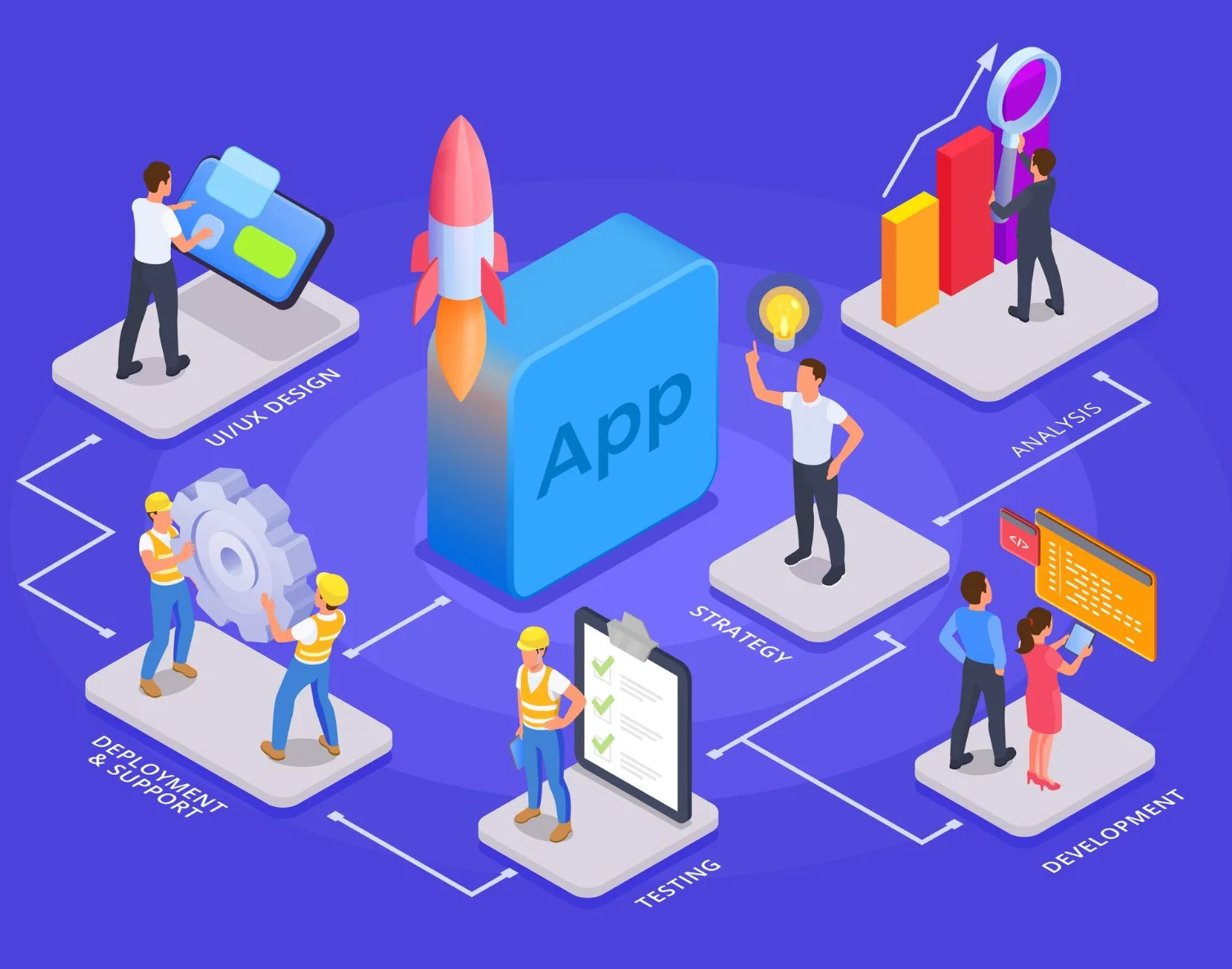
We have a structured development process to ensure systems truly meet business needs.
1. Business Analysis
Studying company workflows and operational requirements.
2. System Planning
Creating system architecture and operational flow.
3. UI/UX Design
Designing a modern and user-friendly interface.
4. Development
Coding process and system construction.
5. Testing
Testing system stability and security.
6. Deployment
Implementing the system into company operations.
7. Maintenance & Support
Long-term support and development.
Enterprise Applications and the Challenges of Modern Business Operations
The larger a company grows, the more complex its operations become. Many businesses initially operate with simple systems, but as transactions increase, team sizes grow, and workflows lengthen, manual processes become a major bottleneck.
The most common problems usually arise not from a lack of sales, but because internal operations are not equipped to keep pace with business growth.
For example:
Inter-departmental approvals are too slow
Discrepant data between finance and operations
Sales teams struggle to track customers
Reporting takes days
Information is scattered across many platforms
Human errors increase due to manual input
Owners find it difficult to monitor the business in real-time
These issues often lead to companies losing efficiency, decreasing team productivity, and slowing business growth.
Therefore, modern enterprise applications function not merely as administrative software, but as a central hub for comprehensive business operations management.
The Importance of Inter-Departmental Integration within a Company
One of the biggest challenges within companies is inter-departmental synchronization.
Many companies still use separate systems:
Finance uses its own software
Sales uses spreadsheets
Warehousing uses manual record-keeping
HR uses a different platform
Customer service uses WhatsApp without a system
As a result:
Data is not synchronized
Much work is duplicated
Approval processes are slow
Reporting is inaccurate
Monitoring business performance is difficult
Custom enterprise applications help integrate all departments into one interconnected digital ecosystem.
For example:
When sales makes a transaction:
Data automatically enters finance records
Inventory is automatically updated
The owner's dashboard instantly changes
Purchasing receives alerts for minimum stock levels
Customers receive automatic notifications
Such integration helps companies operate much faster and more efficiently.
Enterprise Applications as a Business Intelligence Hub
Modern companies require real-time data to make business decisions quickly.
Therefore, enterprise applications are now frequently developed with business intelligence dashboard features.
These dashboards help management monitor:
Daily sales
Company KPIs
Team productivity
Branch performance
Conversion rates
Cash flow
Inventory movement
Customer retention
Sales pipeline
Business profitability
With a good analytics dashboard, companies no longer need to wait for manual reports to understand their business status.
The Importance of Workflow Automation in Enterprise Applications
One of the main goals of digitalization is to reduce repetitive work.
Many operational activities can actually be automated, such as:
Approval Workflow
Previously:
Approvals were done via chat or email
Tracking approval status was difficult
Documents often piled up
After automation:
Approvals run automatically within the system
Status can be monitored in real-time
Automatic notifications are sent to relevant parties
Reporting Automation
Previously:
Teams had to create manual reports daily
After automation:
Dashboards and reports are updated automatically
Task Management Automation
The system can:
Create automatic reminders
Automatically assign tasks
Monitor deadlines
Track work progress
Workflow automation helps companies increase efficiency without needing to add significant manpower.
Enterprise Applications and Business Scalability
Many businesses struggle to scale up because their internal operations are not ready.
For example:
Sales increase, but operations are overwhelmed
Many branches are difficult to monitor
Data between teams is not synchronized
Old systems cannot handle high traffic
Therefore, scalability is an important factor in the development of modern enterprise applications.
The system must be able to:
Handle user growth
Handle increased transactions
Support multiple branches
Support new integrations
Store large amounts of data
Remain stable under high traffic
At BMS Services Indonesia, enterprise application development always considers long-term scalability so that systems remain optimal as businesses grow.
API Integration in Modern Enterprise Applications
Current enterprise applications rarely stand alone. Systems usually need to connect with various external platforms.
Examples of commonly used integrations:
WhatsApp API
Payment gateway
Marketplace
ERP
CRM
Accounting software
HR system
Google Workspace
Email automation
Logistic system
However, API integration also has technical challenges such as:
API Rate Limit
Some services limit the number of API requests within a certain period.
If not designed correctly:
Data synchronization becomes slow
Notifications fail to send
Data is not real-time
Data Mapping Error
Each platform has a different data structure, requiring detailed mapping for synchronization.
Webhook Failure
Webhooks are used for real-time synchronization between systems, but issues such as timeouts or invalid payloads often occur if the system architecture is not well-designed.
Therefore, modern enterprise applications require mature architectural planning from the initial development stage.
Cloud Infrastructure for Enterprise Applications
Many companies are now migrating to cloud infrastructure because it is more flexible and scalable.
Advantages of cloud systems:
Access from anywhere
Multi-branch monitoring
Easier maintenance
Automatic backup
High availability
Higher scalability
Cloud infrastructure also helps companies reduce reliance on local servers, which are more expensive and difficult to manage.
Data Security in Enterprise Applications
Company data is a critical asset, making system security a top priority.
Modern enterprise applications typically include security features such as:
Role management
Multi-level access
Authentication system
SSL encryption
Database protection
Activity log
Automatic backup
Session management
Security is especially crucial for systems that store:
Customer data
Transaction data
Financial data
Internal company documents
The Role of AI in Modern Enterprise Applications
AI automation is becoming one of the biggest developments in modern business software.
AI integration helps companies operate more efficiently through:
AI Customer Support
Answering customer inquiries automatically 24/7.
AI Analytics
Helping to interpret business trends and predict data.
AI Workflow Automation
Automating repetitive administrative tasks.
AI Sales Assistant
Assisting with automated follow-ups and lead qualification.
AI Document Processing
Helping to read and process documents faster.
In the future, enterprise applications will become increasingly integrated with AI to enhance operational efficiency and business decision-making.
Business Websites as the Frontend of Operational Systems
Modern websites no longer simply function as company profiles.
In many companies, websites serve as the frontend for various operational systems such as:
CRM
Business dashboards
Customer portals
ERP systems
Inventory management
AI chatbot
Booking systems
Helpdesk platforms
Users only see a simple website interface, but behind it, complex operational systems run automatically.
This approach helps companies build a more integrated digital ecosystem.
The Future of Enterprise Applications
Digital transformation will continue to evolve, and companies slow to adapt will fall further behind.
Going forward, enterprise applications will increasingly move towards:
AI-powered system
Predictive analytics
Real-time business intelligence
Hyper automation
IoT integration
Cloud-native infrastructure
Smart workflow automation
Therefore, investment in enterprise applications should not be seen merely as a technology expense, but as a critical foundation for long-term business growth.
Companies with robust digital operational systems will be better prepared to face market changes, enhance work efficiency, and build a more scalable business in the modern digital era.
Why Choose BMS Services?
BMS Services Indonesia helps companies build digital systems that are truly relevant to operational needs.
Our advantages:
Custom software tailored to business workflows
Experienced developer team
Modern and user-friendly UI
Multi-platform integration
Long-term support
Focus on operational efficiency
Scalable for business growth
We understand that enterprise applications are not just software, but a vital foundation for digital transformation in modern business.
If your company is experiencing operational bottlenecks, excessive manual processes, or difficulty monitoring your business in real-time, then it's the right time to start building an integrated digital system.
Our team is ready to help design custom enterprise applications that meet your business's operational needs.
Consult your business's digitalization needs with BMS Services and build a modern operational system ready to support your company's long-term growth.