Professional ERP System Development Services for Businesses
Need a custom ERP system? BMS Services helps digitalize businesses with scalable ERP for operations, finance, HR, and workflow.
ERP System Development Services to Increase Business Efficiency and Scalability
In today's digital age, companies are required to work faster, more efficiently, and in an integrated manner. Many businesses still use manual processes or separate software to manage daily operations. As a result, data becomes unsynchronized, workflows are slow, and decision-making is less effective.
This is why more and more companies are starting to use ERP systems to support their business operations.
An ERP system, or Enterprise Resource Planning, is an integrated system that helps companies manage various business processes on a single platform. From finance, inventory, purchasing, HR, sales, production, to business reports, everything can be accessed in real time through one centralized system.
BMS Services provides custom ERP system development services designed to meet your business needs. With the right ERP solution, companies can significantly increase productivity, reduce human error, and accelerate business growth.
What is an ERP System?
An ERP system is software that integrates all business processes into one interconnected system. This system allows every division within the company to use the same data in real-time.
For example:
Sales teams can view stock status directly
Finance teams can monitor automated transactions
HR can manage employee data in one dashboard
Management can view business reports anytime
Without an ERP system, companies typically use many different applications that are not interconnected. This leads to:
Data duplication
Input errors
Slow processes
Difficult reporting
Ineffective inter-divisional communication
With an ERP system, all business operations become more structured and efficient.
Why Do Businesses Need an ERP System?

As businesses grow, operational complexity also increases. Manual management, which was previously effective, will start to cause many problems.
Here are some reasons why ERP systems are crucial for modern businesses:
1. Integration of All Divisions
ERP connects all parts of a company within one centralized system.
From:
Sales
Purchasing
Warehouse
Finance
HR
Production
Customer Service
All data is stored in one database, making it easier to access and manage.
2. Reduce Human Error
Manual processes are highly susceptible to data entry errors.
ERP helps automate various processes such as:
Invoices
Purchase orders
Payroll
Stock updates
Reporting
With automation, the risk of human error can be significantly reduced.
3. Accelerate Operational Processes
ERP enables companies to work faster because all information is available in real-time.
For example:
Faster approvals
More accurate stock monitoring
Automated report generation
Easier transaction tracking
This helps improve the company's operational efficiency.
4. Aid Decision Making
ERP provides real-time dashboards and business reports.
Management can see:
Sales
Cash flow
Profit
Inventory movement
Employee productivity
With accurate data, decision-making becomes faster and more precise.
5. Support Business Scalability
ERP systems help companies grow without having to add complex manual processes.
The system can be developed according to business needs:
Branch expansion
Multi-warehouse support
Multi-user support
Multi-company support
API integration
Mobile access
Want more integrated and efficient business operations? Consult your company's ERP system needs with the BMS Services team.
Types of ERP System Modules
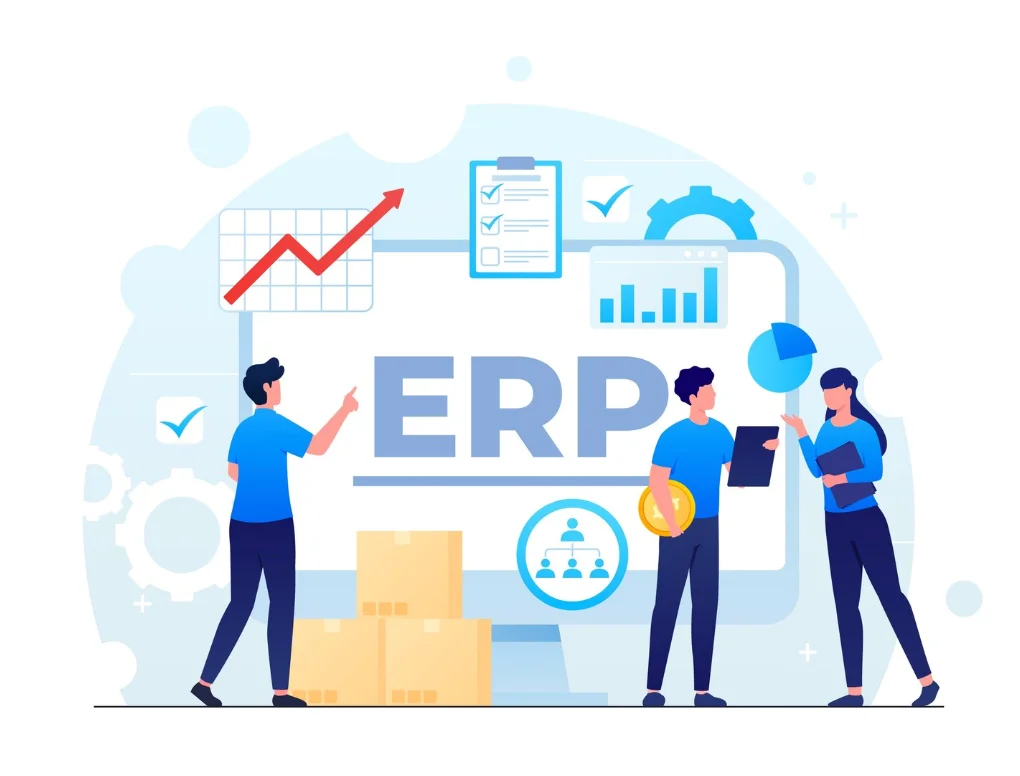
ERP systems typically consist of various modules that can be customized to suit the company's needs.
Finance & Accounting Module
Helps manage:
Cash flow
Invoices
Taxes
General ledger
Financial reports
Budgeting
Inventory Management Module
Used for:
Stock monitoring
Stocktaking
Warehouse management
Barcode system
Tracking incoming and outgoing goods
Sales & CRM Module
Helps manage:
Customer database
Sales pipeline
Customer follow-ups
Price quotations
Sales reporting
Purchasing Module
Manages:
Purchase requests
Vendor management
Purchase approvals
Purchase orders
Supplier tracking
Human Resource (HR) Module
Features:
Attendance
Payroll
Employee database
Leave management
Performance review
Production Module
Suitable for manufacturing companies:
Production planning
Bill of materials
Work orders
Quality control
Benefits of Using a Custom ERP System
Many companies use generic ERP software, but often the available features do not truly match their business needs.
Therefore, custom ERP becomes a more flexible solution.
1. Tailored to Business Workflow
Every company has a different workflow.
Custom ERP is built based on:
Company SOPs
Organizational structure
Operational processes
Specific business requirements
2. More Flexible for Development
Custom ERP is easier to upgrade as the business grows.
You can add:
New modules
Application integrations
Additional dashboards
Automation workflows
3. Better Data Security
Company data is a critical asset.
Custom ERP allows for:
Access rights configuration
Data encryption
Automatic backups
Dedicated company servers
With a robust security system, companies can keep business data safe and controlled.
Boost team productivity and accelerate business processes with a custom ERP system from BMS Services.
ERP System Development Process at BMS Services

BMS Services provides professional and scalable ERP system development services.
Here are the work stages:
1. Business Analysis
The team conducts an analysis of:
Business workflow
Operational challenges
System requirements
Company targets
2. System Planning
After analysis, the team creates:
System structure
User flow
Database architecture
ERP features
3. UI/UX Design
The ERP is designed to be:
Easy to use
Responsive
User-friendly
Efficient for daily operations
4. Development Process
The development team starts building the system using modern and scalable technologies.
5. Testing & QA
Before launching, the system is tested to ensure:
No bugs
Optimal security
Stable performance
6. Deployment & Training
After the system is complete:
ERP is implemented
User training is conducted
Support and maintenance are provided
ERP System Implementation Case Studies
Case Study 1: Distribution Company
Problem
The company experienced:
Stock errors
Unsynchronized sales data
Slow manual reporting
Solution
BMS Services built an integrated ERP system with:
Inventory management
Sales dashboard
Purchasing automation
Results
Operational efficiency increased by 45%
Human errors drastically reduced
Real-time reports available anytime
Case Study 2: Manufacturing Company
Problem
The company struggled to monitor:
Production
Raw materials
Production timeline
Solution
An ERP production management system was developed with:
Production tracking
BOM management
Warehouse integration
Results
Production is more controlled
Raw material usage is more efficient
Production delays decreased
Case Study 3: Multi-Branch Retail Company
Problem
Each branch used a different system, making data centralization difficult.
Solution
A multi-branch ERP was implemented with:
Centralized dashboard
Stock integration
Real-time sales monitoring
Results
Monitoring all branches became easier
Automated business reports
Faster decision-making
ERP System and Business Automation
An ERP system is not just data recording software, but also an important part of business automation.
With ERP, various processes can run automatically:
Approval workflows
Invoice reminders
Automatic stock updates
Purchase notifications
Automated reporting
Automation helps companies work faster and more efficiently.
See also:
Business Automation
CRM Development Services
Custom Software Development
Digital Transformation
Signs Your Business Needs an ERP System
Here are some signs your company needs an ERP:
Data is still manual in Excel
Many processes involve double entry
Difficult to generate reports
Divisions are not synchronized
Stock issues are frequent
Approvals take too long
Operations are becoming complex
If these issues are occurring, ERP can be the best solution to improve business efficiency.
Business Challenges Without an ERP System
Many companies experience rapid business growth, but internal operations still rely on manual methods or separate software. In the long run, this can hinder the company's development.
Some common challenges without an ERP system include:
Unsynchronized Data Across Divisions
When each division uses a different system, data is often not well connected. Finance, sales, warehouse, and purchasing teams have their own data, leading to:
Discrepant reports
Stock errors
Delayed approvals
Difficulty monitoring business
An ERP system helps consolidate all data into one integrated platform, allowing all divisions to work more efficiently.
ERP Systems Aid Digital Transformation
Digital transformation is not just about using new software, but about how companies can improve efficiency through technology.
An ERP system is a key foundation of digital transformation because it can:
Automate workflows
Reduce manual processes
Increase data transparency
Accelerate decision-making
Simplify operational monitoring
Companies that adapt more quickly to technology typically have higher competitiveness compared to competitors still using conventional processes.
Importance of Real-Time Dashboards and Reporting
One of the biggest advantages of using an ERP system is the ability to view business data in real-time.
Management dashboards allow companies to monitor:
Daily sales
Company profit
Cash flow
Branch performance
Team productivity
Inventory status
Purchase orders
Business targets
With constantly updated reports, management can make faster and more accurate decisions.
ERP Systems for Various Industries
ERP systems can be used for various types of industries and business models.
ERP for Distribution Companies
Helps manage:
Multi-warehouse
Goods distribution
Sales monitoring
Purchase management
Stock tracking
ERP for Manufacturing
Commonly used features:
Production planning
Quality control
Bill of materials
Production tracking
ERP for Retail
Helps with:
Sales monitoring
POS integration
Stock management
Multi-branch support
ERP for Services
ERP can be used for:
Project management
HR management
Invoice management
Customer tracking
ERP Integration with Other Systems
Modern ERP can be integrated with various platforms to enhance business efficiency.
Integration examples:
Payment gateways
Marketplaces
CRM systems
HRIS
Accounting software
WhatsApp API
Email automation
E-commerce platforms
This integration helps all business processes run more automatically and with minimal friction.
Data Security in ERP Systems
Data security is crucial in ERP system development because the system stores a large amount of company information.
BMS Services considers various security aspects such as:
User role management
Data encryption
Backup system
Activity logs
Secure authentication
Server protection
With a robust security system, companies can keep business data safe and controlled.
Cloud-Based ERP System
Many companies are now switching to cloud-based ERP systems because they are more flexible and efficient.
Advantages of cloud-based ERP:
Accessible from anywhere
Does not require large internal servers
Easier maintenance
High scalability
Suitable for multi-branch companies
Cloud ERP greatly assists companies with hybrid and remote work systems.
ROI Using an ERP System
ERP system investment often has a significant impact on business efficiency and profitability.
Some long-term benefits:
Reduce operational costs
Minimize human error
Save work time
Increase productivity
Accelerate business workflows
In many cases, ERP helps companies significantly increase operational efficiency within a few months of implementation.
Future Scalability of ERP Systems
Growing businesses require systems that can also evolve to meet company needs.
Custom ERP allows for:
Adding users
Adding branches
Adding new modules
Integrating new technologies
Additional workflow automation
Therefore, ERP is a critical long-term investment for modern business growth.
Why Is Custom ERP More Effective Than Generic Systems?
Generic ERP software often has limitations because it is built for the needs of many types of businesses simultaneously.
However, custom ERP offers advantages:
More tailored workflows
More relevant features
Easier-to-use interface
Flexible for development
No need to pay for unneeded features
This makes ERP implementation more effective for company operations.
Why Choose BMS Services?
BMS Services helps companies build scalable ERP systems tailored to business needs.
Advantages:
Custom ERP aligned with business workflow
Professional development team
Modern UI/UX
Scalable system
Support and maintenance
API integration
Optimal data security
BMS Services focuses on helping companies achieve effective and sustainable digital transformation.
Every business has different needs. BMS Services helps build ERP systems specifically designed for your company's operational processes.