ERP Implementation: Effective Strategies and Phases
Learn ERP implementation from strategy, stages, benefits, and challenges to case studies and success factors to improve business efficiency.
ERP Implementation: Strategy, Stages, and Success Factors for Sustainable Business Transformation
In the digital age, companies are required to move faster, more efficiently, and more accurately in managing business operations. Increasingly fierce competition means companies can no longer rely on manual processes, separate spreadsheets, or unintegrated systems.
Many organizations face challenges such as data spread across various departments, slow approval processes, data input errors, and difficulty obtaining real-time reports. These conditions lead to less effective decision-making and potentially hinder business growth.
One solution widely used by companies to overcome these challenges is ERP implementation. ERP (Enterprise Resource Planning) allows all business processes to run within one integrated system, enabling companies to increase efficiency, productivity, and control over operations.
However, ERP implementation is not just a software installation project. ERP implementation is a business transformation process that involves changes in work processes, organizational culture, and decision-making methods. Therefore, companies need to understand the strategy, stages, and success factors of ERP implementation to ensure that their investment yields optimal results.

What is ERP implementation?
ERP implementation is the process of planning, configuring, integrating, data migrating, testing, user training, and deploying an ERP system to all parts of an organization.
ERP is designed to integrate various business functions such as:
Finance and accounting
Sales
Purchasing
Inventory management
Production
Human resources
Supply chain
Customer service
Project management
With ERP, all departments use the same data source, making information more accurate and consistent.
Why do companies need ERP implementation?
Scattered business data
Many companies use different applications for each department. As a result, data becomes siloed and difficult to synchronize.
Slow operational processes
Purchase approvals, stock checks, and report generation often take a long time because they are still done manually.
High human error rate
Repeated data entry increases the risk of errors that can impact reports and operations.
Difficulty obtaining real-time reports
Management needs quick information to make decisions. Without ERP, reports are often only available after manual reconciliation is complete.
Increasing business complexity
As businesses grow, the number of transactions increases and operational processes become more complex. ERP helps companies manage this complexity.
ERP implementation as the foundation of digital transformation
Many companies view ERP as merely administrative software. However, ERP is the primary foundation of a company's digital transformation.
Digital transformation aims to connect all business processes so that companies can operate more efficiently and data-driven.
With proper ERP implementation, companies can gain benefits such as:
Operational transparency
Data-driven decision making
Business process efficiency
Reduced operational costs
Increased productivity
Better inter-departmental collaboration
Higher business scalability
ERP becomes the company's data hub that supports long-term growth.
Effective ERP implementation strategy
Defining clear business objectives
Before commencing ERP implementation, companies must establish the targets they wish to achieve.
Examples of objectives:
Reduce manual processes by up to 70%
Accelerate financial report closing
Improve inventory accuracy
Integrate all branches
Reduce operational costs
Clear objectives help companies measure implementation success.
Securing management support
ERP implementation requires support from directors and top management.
Without such support, ERP projects often lose priority and face obstacles in decision-making.
Mapping business processes
Before the system is configured, companies must understand the current workflow.
This stage includes:
Business process mapping
Bottleneck identification
Needs analysis
SOP development
A good ERP should support efficient business processes.
Forming a project team
The implementation team typically consists of:
Project sponsor
Project manager
Key user
IT team
ERP consultant
Good collaboration among the team is a critical factor in implementation success.
Most frequently implemented ERP modules
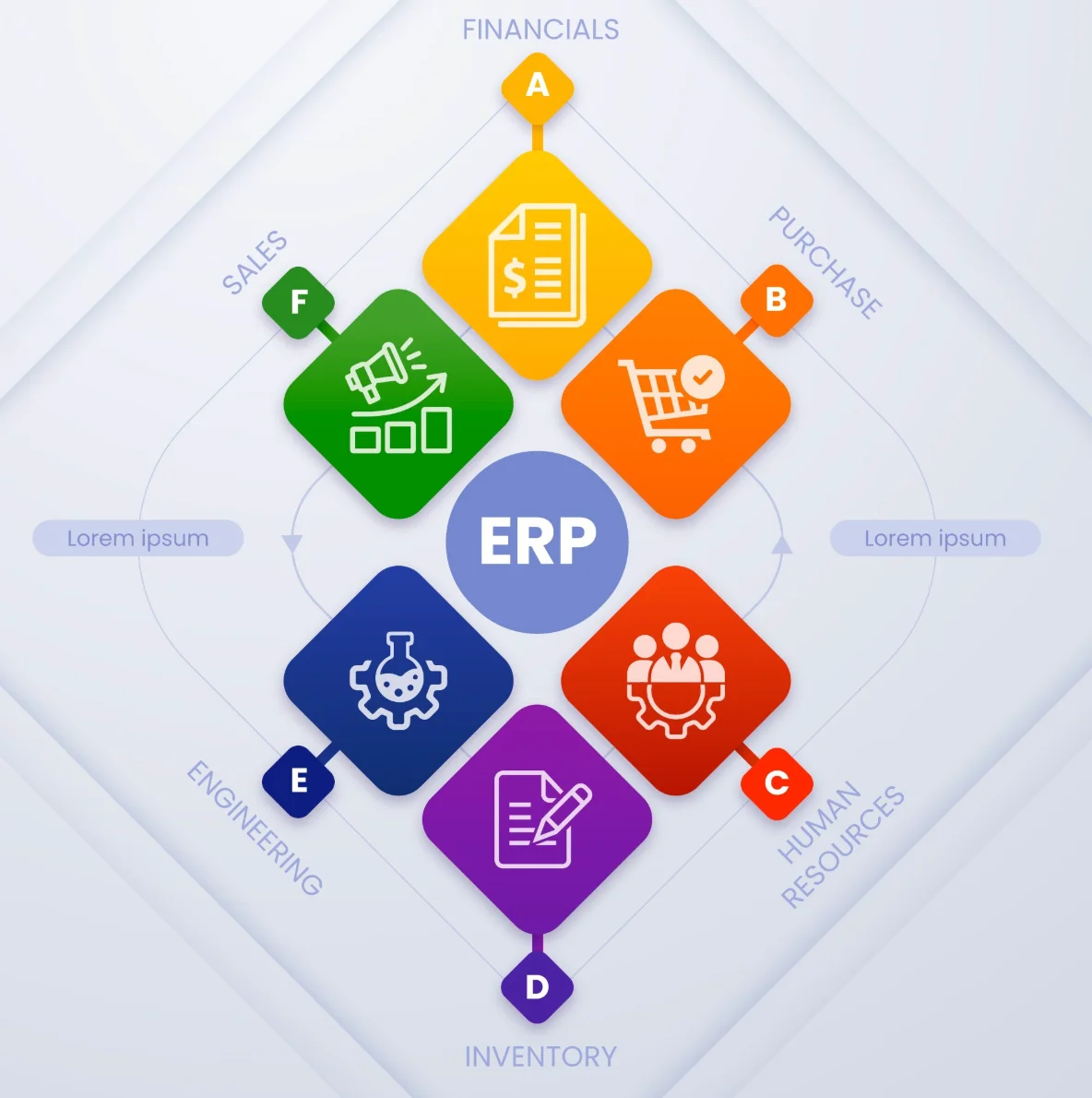
Finance and accounting module
This module helps companies manage:
General ledger
Accounts payable
Accounts receivable
Cash flow
Budgeting
Financial reporting
Inventory management module
Helps control inventory in real-time.
Benefits:
Reduce stock-outs
Reduce overstocking
Accelerate stock-taking
Improve inventory accuracy
Purchasing module
Manages the entire procurement process.
Key features:
Purchase request
Purchase order
Vendor management
Approval workflow
Sales module
Helps manage the sales process from start to finish.
Human resource module
Includes:
Employee data
Payroll
Attendance
Performance appraisal
Leave management
Manufacturing module
Designed for manufacturing companies.
Covers:
Bill of Material
Production planning
Work order
Quality control
Material Requirement Planning
ERP implementation stages
1. Requirements analysis
The initial stage to understand business needs and operational processes.
Activities:
User workshops
Requirement gathering
Business process analysis
Preparation of requirements documents
2. Project planning
Includes:
Timeline preparation
Budget determination
Resource allocation
Risk identification
3. Design and configuration
ERP is configured according to business needs.
Includes:
Master data setup
Approval workflow
User access rights
Organizational structure
4. Data migration
Data from the old system is migrated to the ERP.
Migrated data:
Customers
Suppliers
Products
Stock
Transactions
5. System testing
Testing is performed to ensure all processes run smoothly.
Types of testing:
Unit testing
Integration testing
User Acceptance Testing
6. User training
Users must understand how to use the ERP effectively.
Training can include:
Workshops
Transaction simulations
Documentation
Video tutorials
7. Go-live
The ERP is officially launched for use by the entire organization.
8. Hypercare and optimization
Post-implementation support phase to ensure the system operates optimally.
ERP implementation methods
Big Bang Implementation
All modules are launched simultaneously.
Advantages:
Fast
Disadvantages:
High risk
Phased Implementation
Implementation is carried out in stages.
Advantages:
Lower risk
Disadvantages:
Longer project duration
Parallel Implementation
The new ERP runs alongside the old system for a certain period.
Advantages:
More secure
Disadvantages:
Higher workload
Factors for successful ERP implementation
Strong leadership
Management must actively support the project.
Competent project team
The team must understand business processes and implementation goals.
Good data quality
Poor data will lead to inaccurate information.
Adequate user training
Users who understand the system will adapt more easily.
Effective change management
Changes to work processes must be effectively communicated to all employees.
Selecting the right implementation partner
The implementation partner plays a significant role in the success of an ERP project.
KPIs to measure ERP implementation success
Several indicators can be used:
Operational efficiency
Transaction processing time
Reduction of manual tasks
Data accuracy
Transaction error rate
Inventory accuracy
Productivity
Number of transactions processed
Task completion time
Financial performance
Reduction in operational costs
ROI of ERP implementation
Challenges of ERP implementation
Some common challenges include:
User resistance
Low data quality
Scope creep
Project delays
Budget overruns
Lack of training
Thorough planning helps mitigate these risks.
ERP implementation case study in a distribution company
A distribution company with five branches faced these problems:
Before ERP
Unsynchronized stock data
Delayed financial reports
Many manual processes
High human error rate
Solution
The company implemented:
Finance ERP
Inventory ERP
Purchasing ERP
Sales ERP
Results
Increased stock accuracy
Real-time reports available
Improved productivity
Faster purchasing process
More accurate decision-making
ERP implementation case study in a manufacturing company
A manufacturing company experienced:
Production delays
Raw material planning errors
High operational costs
After ERP implementation:
More planned production
More accurate raw material stock
Reduced lead time
Increased efficiency
ERP helps companies integrate all processes from raw material purchasing to product delivery.
How to calculate ERP implementation ROI
One of the biggest questions before starting an ERP implementation is whether the investment will yield a commensurate return. Therefore, companies need to calculate the Return on Investment (ROI) of an ERP project.
The cost components of ERP implementation generally include:
Software license fees
Implementation costs
Consulting fees
Data migration costs
Training costs
Maintenance costs
Server or cloud infrastructure
Meanwhile, quantifiable benefits include:
Reduction in operational costs
Reduction in administrative tasks
Labor efficiency
Decrease in transaction errors
Reduction in inventory costs
Increase in productivity
For example, if a company saves IDR 500 million per year through operational efficiency with an ERP investment of IDR 1 billion, the ROI can be achieved in approximately two years.
Therefore, ERP implementation should be viewed as a long-term strategic investment, not just a technology expense.
ERP implementation across various industries
Each industry has different ERP needs. Therefore, implementation strategies must be tailored to business characteristics.
ERP for manufacturing companies
Manufacturing companies require strict control over production and inventory.
The most frequently used modules:
Production Planning
Manufacturing
Inventory
Procurement
Quality Control
Finance
Key benefits:
More accurate production planning
Reduced downtime
Raw material control
Production cost monitoring
ERP for distribution companies
Distribution companies typically face challenges in inventory and logistics management.
Benefits of ERP implementation:
Real-time stock
Multi-warehouse management
Shipment tracking
Sales and inventory integration
ERP for retail companies
ERP helps retailers manage:
POS
Inventory
Supplier
Loyalty Program
Finance
With ERP, companies can track best-selling products, inventory movement, and branch performance in real time.
ERP for Construction Companies
In the construction industry, ERP helps manage:
Project budgets
Materials
Manpower
Procurement
Project cash flow
This is crucial to avoid cost overruns and project delays.
ERP for Service Companies
Service companies require better resource and project management.
ERP can help with:
Timesheets
Resource planning
Billing
Project management
Profitability analysis
Cloud ERP vs. On-Premise ERP
Before ERP implementation begins, companies need to determine the appropriate deployment model.
Cloud ERP
Cloud ERP is accessed via the internet and managed by a service provider.
Advantages:
Lower initial investment
Faster implementation
Easier maintenance
High scalability
Disadvantages:
Reliance on internet connection
Limited infrastructure control
On-Premise ERP
ERP is installed on the company's own servers.
Advantages:
Full control over data
High configuration flexibility
Disadvantages:
Large initial investment
Requires an internal IT team
More complex maintenance
Importance of Business Process Reengineering Before ERP Implementation
One common mistake is migrating old processes into ERP without evaluation.
However, ERP implementation is an opportunity to improve inefficient business processes.
Business Process Reengineering (BPR) helps companies:
Eliminate unnecessary processes
Reduce bureaucracy
Accelerate workflows
Increase productivity
Successful ERP projects typically begin with business process improvement.
Change Management in ERP Implementation
Many ERP projects fail not because of technology, but because of people.
Employees accustomed to old systems often feel apprehension about change.
Some common forms of resistance include:
Refusing to use the new system
Fear of losing jobs
Distrust of ERP benefits
Difficulty adapting
Therefore, companies need to implement a change management strategy.
Steps that can be taken:
Communicate from the start
Explain the reasons for ERP implementation and its benefits for the company and employees.
Involve users
Invite representatives from each department to participate in the implementation process.
Provide adequate training
Ensure all users understand how to use the system.
Provide post-implementation support
Support after go-live helps increase system adoption rates.
ERP implementation risks and mitigation strategies
Project delay risk
Causes:
Overly broad scope
Lack of resources
Changing requirements
Mitigation:
Defining a clear scope
Creating a realistic timeline
Regular progress monitoring
Risk of poor data quality
Causes:
Duplicate data
Incomplete data
Historical errors
Mitigation:
Data cleansing
Data validation
Data audit before migration
Risk of cost overruns
Causes:
Excessive customization
Scope creep
Poor planning
Mitigation:
Determining implementation priorities
Controlling requirement changes
Using a structured implementation methodology
ERP integration with other systems
Modern ERP does not stand alone.
Many companies integrate ERP with various other systems to create a connected digital ecosystem.
Examples:
ERP and CRM
This integration helps synchronize customer, sales, and customer service data.
ERP and HRIS
Connects attendance, payroll, and employee management data.
ERP and e-commerce
Enables automatic synchronization of stock and orders.
ERP and marketplace
Helps manage orders from various platforms in one dashboard.
ERP and business intelligence
Provides analytical dashboards and more in-depth reports.
Long-term ERP implementation roadmap
ERP implementation does not stop after go-live.
A company should have a long-term development roadmap.
Year 1
System stability
User training
Process optimization
Year 2
Additional system integration
Dashboard development
Workflow automation
Year 3
Advanced analytics
AI and forecasting
Business intelligence
This approach helps companies gain maximum benefits from their ERP investment.
Why do many ERP projects fail?
Based on various studies and industry experience, the primary causes of ERP implementation failure include:
Lack of management support
Unclear project objectives
Low data quality
Insufficient training
Scope creep
Incorrect vendor selection
Weak change management
Understanding these factors helps companies avoid making the same mistakes.
Why choose an ERP solution that suits your business?
No single ERP fits all companies.
Each industry has different needs:
Manufacturing
Distribution
Retail
Construction
Professional services
Healthcare
Therefore, ERP implementation must be tailored to existing business processes to maximize benefits.
BMS Services helps companies design and implement ERP solutions that align with operational needs, workflows, and business growth targets. Our process-focused approach ensures that the system built not only functions technically but also delivers a tangible impact on the company's efficiency and productivity.