Enterprise Management Systems: Concepts and Benefits
Learn enterprise management systems completely: definitions, how they work, benefits, case studies, and their implementation to improve your business efficiency.
Company Management System: Definition, Benefits, and How It Works, Explained Completely
In today's digital age, companies are required to work faster, more efficiently, and in a structured manner. One of the main keys to achieving this is by implementing an integrated company management system.
Without a clear system, companies often face various problems such as unsynchronized data, slow work processes, and errors in decision-making. Therefore, understanding and managing a company management system is an important step for sustainable business growth.
What is a Company Management System?

A company management system is a set of processes, procedures, technologies, and resources used to manage all business activities in a structured and integrated manner.
This system covers important functions such as:
Finance
Operations
Human resources (HR)
Sales and marketing
Inventory management
With an integrated system, all company data can be accessed in real-time, increasing efficiency and accuracy in business operations.
Types of Company Management Systems
A company management system is not just one form. Each company can use a combination of several systems according to its business needs.
1. Operational Management System
Focuses on day-to-day activities such as production, distribution, and services. This system ensures all processes run efficiently and according to standards.
Examples:
Inventory management
Production scheduling
Monitoring operational team performance
2. Financial Management System
Manages cash flow, financial reports, and company budget planning.
Key functions:
Controlling expenses
Preventing waste
Assisting financial decision-making
3. HR Management System (Human Resource Management)
Focuses on employee management.
Scope:
Recruitment
Attendance & payroll
Performance evaluation
Employee development
4. Information Management System
Manages company data and information to be easily accessible and usable.
Examples:
Customer database
Real-time reporting systems
Business dashboards
Key Components in a Company Management System
For the system to run optimally, there are several key components that must be present:
1. Planning
Defining goals, strategies, and workflows.
Without clear planning, the system will operate without direction.
2. Organizing
Structuring teams, task distribution, and responsibilities.
3. Actuating
Execution of the plan.
At this stage, leadership plays a crucial role.
4. Controlling
Monitoring and evaluation to ensure everything proceeds according to target.
Key Components of an Enterprise Management System
For an optimal system, there are four key components:
1. People (Human Resources)
Employees are the primary users of the system. Without a good understanding, the system will not function effectively.
2. Process (Business Process)
All activities must have a clear flow, such as SOPs, workflows, and approvals.
3. Technology
This includes software such as ERP, CRM, or custom systems used to manage business processes.
4. Data
Data forms the basis for decision-making. Inaccurate data will lead to incorrect decisions.
Why Is an Enterprise Management System Important?
Many companies still use manual systems or unintegrated applications. This leads to:
Scattered and unsynchronized data
Slow work processes
High human error
Difficulty in making strategic decisions
With an enterprise management system, all processes can be unified on one platform, leading to greater efficiency and control.
Widely Used Enterprise Management System Frameworks
To ensure that the management system does not operate haphazardly, companies typically use proven frameworks.
1. PDCA (Plan – Do – Check – Act)
This framework is commonly used for continuous improvement.
Plan: Define goals and strategies
Do: Execute the plan
Check: Evaluate results
Act: Implement improvements and standardization
Advantages:
Suitable for all business types
Easy to implement
Focuses on continuous improvement
2. Balanced Scorecard (BSC)
Used to measure performance from various perspectives, not just financial.
Four main perspectives:
Financial
Customer
Internal business processes
Learning & growth
Examples:
Companies not only look at profit, but also:
Customer satisfaction
Team productivity
Innovation
3. ISO Management System
International standards for company management systems.
Examples:
ISO 9001 -> Quality management
ISO 14001 -> Environment
ISO 45001 -> Occupational health & safety
Advantages:
Increases business credibility
Facilitates global expansion
Clearer work standards
System Integration: The Key to Efficiency
Many companies fail not because they don't have systems, but because their systems are not integrated.
Examples of Problems Without Integration:
Sales data differs from financial data
Marketing and sales teams are not synchronized
HR is not connected to employee performance
Solution: Integrated System (ERP)
With an integrated system:
All data is on one platform
Real-time information
Reduced human error
Examples of integration:
Sales → automatically entered into financial reports
HR → connected to KPIs
Inventory → synchronized with sales
The Role of Technology in Modern Management Systems
In the digital era, management systems cannot be separated from technology.
1. Cloud Computing
Allows access to systems from anywhere.
Benefits:
High flexibility
No physical servers needed
More cost-effective
2. Automation
Reduces manual work.
Examples:
Automatic invoices
Automatic payroll
System notifications
3. Data Analytics
Transforms data into insights.
Usage examples:
Sales forecasting
Customer behavior analysis
Marketing strategy optimization
4. Artificial Intelligence (AI)
Used for faster and more accurate decision-making.
Examples:
Chatbot customer service
Product recommendations
Business forecasting
KPI (Key Performance Indicator) in Management Systems
Without KPIs, the success of a management system cannot be measured.
Examples of KPIs by Division
1. Finance
Revenue growth
Profit margin
Cash flow
2. Marketing
Conversion rate
Cost per lead
ROI campaign
3. Operations
Production time
Process efficiency
Error rate
4. HR
Employee retention rate
Employee productivity
Absenteeism rate
Management System Implementation Stages (Step-by-Step)
For a more practical approach, here are realistic implementation stages:
1. Needs Analysis
Identify:
Key business problems
Inefficient processes
Team needs
2. System Design
Create a blueprint:
Workflow
System structure
Inter-division integration
3. Tool / Software Selection
Choose according to needs:
ERP
CRM
HRIS
4. Phased Implementation
Don’t go for a full system rollout immediately.
Start with:
One division first
Testing
Evaluation
5. Training & Adaptation
Ensure the team:
Understands the system
Is willing to use it
Is not resistant
6. Monitoring & Evaluation
Use KPIs to:
Measure results
Determine improvements
Benefits of a Company Management System
1. Increased Operational Efficiency
Previously manual processes become automated and faster.
2. Inter-Departmental Integration
All divisions can be interconnected within one system.
3. Real-Time Data
Management can access reports at any time without waiting for manual processes.
4. Reduced Human Error
Automation reduces data input errors.
5. Cost Savings
Operational efficiency leads to cost reduction.
6. Supports Scalability
A good system makes it easy for businesses to grow.
Comparison: Manual Systems vs. Integrated Systems
Aspect | Manual System | Enterprise Management System |
Data Processing | Manual | Automatic |
Accuracy | Low | High |
Integration | Separate | Integrated |
Speed | Slow | Fast |
Scalability | Limited | High |
How an Enterprise Management System Works
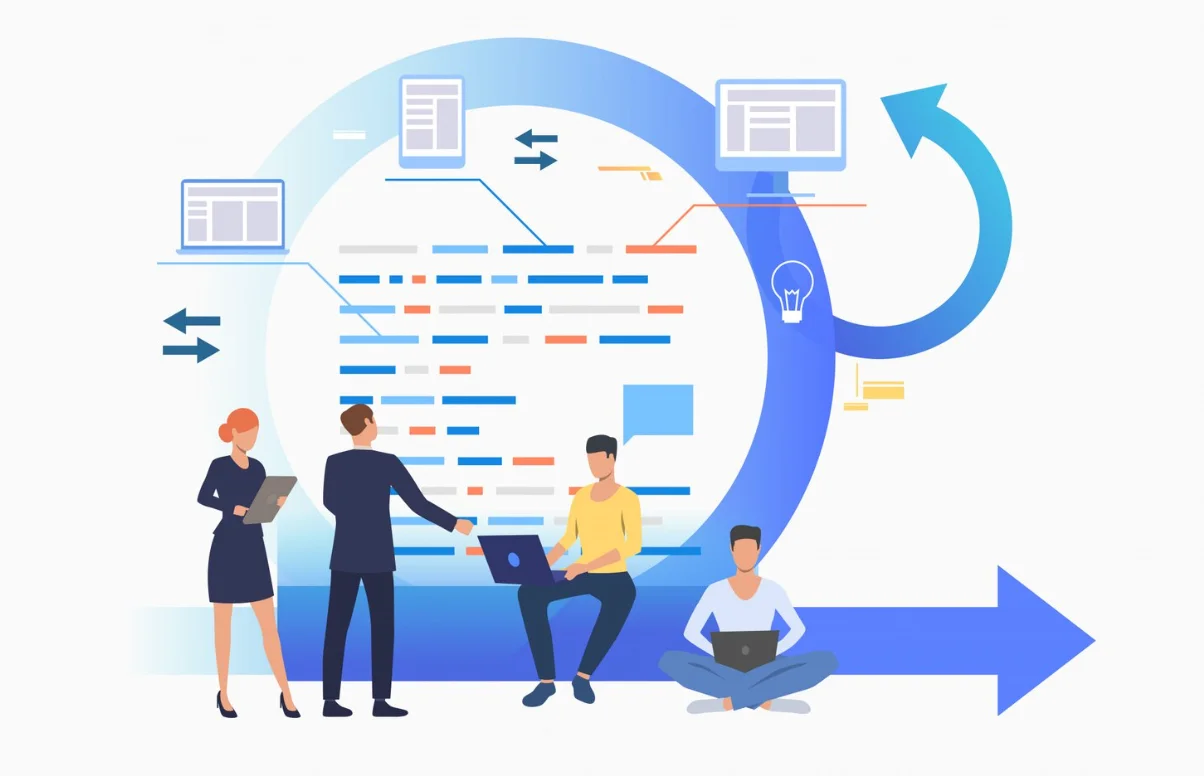
Management systems operate in a repetitive, continuously improved cycle.
1. Input (Data & Resources)
Companies collect data:
Customer data
Sales data
Operational data
2. Process (Data Processing)
Data is processed into usable information:
Sales analysis
Inventory needs prediction
Employee performance evaluation
3. Output (Decisions & Actions)
Analysis results are used to:
Determine business strategies
Make quick decisions
Improve efficiency
4. Feedback (Continuous Improvement)
Decision outcomes are evaluated and improved.
Workflow System Example
Process | Input | System | Output |
Sales | Order | ERP | Invoice |
Procurement | Request | Procurement | PO |
HR | Employee data | HRM | Payroll |
Finance | Transactions | Accounting | Reports |
System Success Indicators
KPI | Before | After |
Process time | Long | Fast |
Errors | High | Low |
Productivity | Low | High |
Reports | Slow | Real-time |
Case Study: Implementation of an Enterprise Management System
Case: Retail Company Experiencing Overstock
Problem:
Excess inventory
Many unsold products
Increased losses
Solution:
The company implemented a data-driven management system:
Using software for stock tracking
Analyzing customer purchasing patterns
Revising distribution strategy
Result:
Better inventory control
Increased sales
Significant reduction in losses
Aspect | Before | After |
Stock accuracy | 70% | 98% |
Reporting time | 7 days | Real-time |
Error | High | Low |
How to Manage an Enterprise Management System
1. Needs Analysis
Identify business processes that need optimization.
2. Choose the Right Technology
Use ERP or custom software according to needs.
3. Create Clear SOPs
The system must be supported by work procedures.
4. Employee Training
Ensure all users understand the system.
5. Monitoring and Evaluation
Evaluate regularly to ensure effectiveness.
Effective Implementation Strategies
Start small
Involve all teams
Use experienced vendors
Focus on process, not just software
Challenges in Implementing Management Systems
Not all companies succeed immediately. There are several common challenges:
1. Employee Resistance
Employees often resist changes to new systems.
Solutions:
Training
Educating on system benefits
2. Implementation Costs
Using digital systems requires investment.
Solutions:
Start small
Use software according to needs
3. Lack of System Integration
Unconnected systems can lead to unsynchronized data.
Solutions:
Use integrated systems like ERP
Tips for Optimizing Enterprise Management Systems
To make the system truly effective, implement the following strategies:
Use technology that suits business needs
Conduct regular evaluations
Involve the entire team in using the system
Use data as the basis for decision-making
Automate repetitive processes
Common Mistakes to Avoid
Not having SOPs
Not conducting training
Using too many tools
Not evaluating the system
Supporting Technologies for Management Systems
Cloud computing
Artificial Intelligence (AI)
Business Intelligence (BI)
Automation tools
These technologies help improve business speed, accuracy, and efficiency.
Conclusion
An enterprise management system is an important foundation for running modern businesses. With an integrated system, companies can increase efficiency, reduce errors, and make decisions faster.
Without a good system, businesses will struggle to grow in a competitive digital era.
Build an Integrated Enterprise Management System Now
If your business is still using manual or unintegrated systems, you are losing efficiency and opportunities.
BMS Services is ready to help you with:
Custom software development
Enterprise management system implementation
Business system integration
Digitalization consultation
Contact our team for a free consultation and start your business's digital transformation today.