Enterprise ERP System for Business Operational Integration
A company's ERP system helps integrate business operations, improve efficiency, reduce human error, and support sustainable growth.
Enterprise ERP System for Business Operational Integration
In an increasingly competitive digital age, companies can no longer rely on spreadsheets, separate applications, or manual processes to manage business operations. As the number of transactions increases, the number of employees grows, and inter-divisional activities become more complex, the need for an integrated system becomes crucial.
This is why more and more companies are adopting an enterprise ERP system as the primary foundation of their digital transformation.
ERP (Enterprise Resource Planning) is an integrated system that connects various business functions on a single, centralized platform. From finance, inventory, procurement, sales, CRM, HR, production, to business intelligence, all can operate using the same real-time data. With this approach, companies can reduce data silos, accelerate operational processes, and improve decision-making accuracy.
What is an Enterprise ERP System?
An enterprise ERP system is software designed to integrate all business processes into a single, interconnected system.
Before using ERP, many companies faced conditions such as:
Financial data in separate accounting software
Customer data stored in different CRM
Inventory recorded in spreadsheets
Purchasing using manual email
HR using different applications for payroll and attendance
This resulted in:
Data duplication
Human error
Delayed reports
Difficulty performing business analysis
Lack of transparency between departments
ERP eliminates these problems by providing a single data source used by all company divisions. Every data change is instantly visible to relevant parties, making business processes faster and more accurate.
Why ERP Systems are a Necessity for Modern Companies?
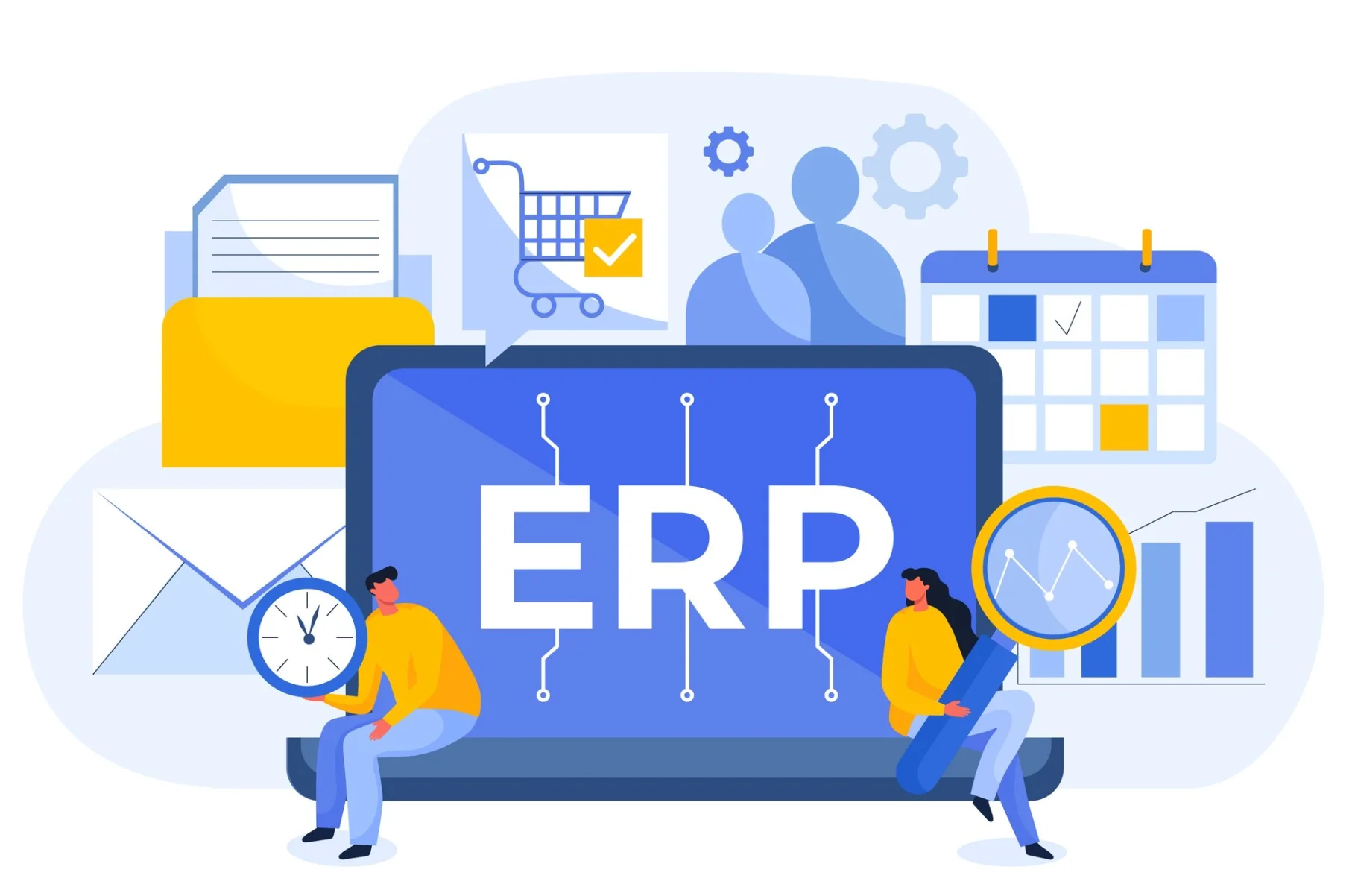
As businesses grow, operational complexity will increase exponentially.
Companies that initially managed with manual processes often begin to face various challenges such as:
1. Data Inconsistency Across Departments
Sales teams record customer transactions.
Finance teams record payments.
Warehouse teams manage inventory.
When these three departments use different systems, data synchronization becomes a major challenge.
ERP ensures all divisions access the same data in real-time, eliminating information discrepancies between departments.
2. Slow Operational Processes
Without integration, each process requires repeated manual input.
For example:
Sales creates an order
Admin re-enters data
Finance creates manual invoices
Warehouse checks stock separately
With ERP, these processes can run automatically through connected workflows.
3. Difficulty Obtaining Business Reports
Many companies take days to compile reports from various departments.
ERP allows management to view business dashboards in real-time whenever needed.
4. High Risk of Human Error
Data input errors can lead to:
Stock errors
Invoice errors
Financial report errors
Production planning errors
Automation in ERP helps minimize these risks.
Key Modules in a Company's ERP System
Modern ERP consists of various modules that can be customized to business needs.
Finance & Accounting Module
This module is central to managing company finances.
Common features include:
General Ledger
Cash Flow Management
Budgeting
Profit & Loss Report
Balance Sheet
Bank Reconciliation
Tax
With integrated data, financial reports can be generated automatically and more accurately.
Inventory Management Module
Crucial for distribution, retail, and manufacturing companies.
Its functions include:
Real-time stock monitoring
Stock opname
Tracking inbound and outbound goods
Multi-warehouse management
Barcode management
Inventory forecasting
Purchasing Module
Manages the entire goods and services procurement process.
Includes:
Purchase Request
Purchase Order
Vendor Management
Approval Workflow
Delivery Monitoring
Sales & CRM Module
Integrates sales activities and customer management.
Key features:
Customer Database
Sales Pipeline
Quotation Management
Customer Tracking
Follow-Up Automation
Human Resource Management Module
Assists in centralized HR management.
Includes:
Employee Database
Payroll
Attendance
Leave Management
Performance Review
KPI Monitoring
Production Management Module
Specifically for the manufacturing industry.
Commonly used features:
Bill of Materials (BOM)
Production Planning
Work Order
Material Requirement Planning
Quality Control
Benefits of Enterprise ERP Systems for Business Operations
Higher Operational Efficiency
With integrated data, administrative tasks can be significantly reduced.
Teams no longer need to repeatedly input data into various systems.
Faster Decision-Making
The ERP dashboard allows management to view business conditions in real-time.
Decisions can be made based on actual data, not assumptions.
Business Scalability
ERP makes it easy for companies to grow without having to replace systems every time the business expands.
Adding branches, warehouses, divisions, and new users can be done more easily.
Improved Transparency
Every activity can be traced through audit trails and a centralized reporting system.
This increases the accountability of all departments.
Enhanced Customer Experience
CRM, inventory, and finance integration enable faster and more accurate customer service.
Case Study of Enterprise ERP System Implementation
Case Study: National Distribution Company
Challenges
A distribution company has 5 warehouses and more than 50 sales personnel.
The issues faced:
Discrepancies in stock data between warehouses
Delayed sales reports
Shipping errors
Slow purchasing process
Solution
An enterprise ERP system was developed that integrates:
Inventory Management
Purchasing
Sales Management
Finance
Dashboard Management
All warehouses were connected within a centralized system.
Results
Within the first six months of implementation:
Stock accuracy drastically improved
Report generation time reduced from several days to real-time
Shipping errors significantly decreased
Purchase approval process became faster
The company can now monitor all operational activities from a single central dashboard.
Cloud ERP vs. Custom ERP: Which is Right for You?
Many companies consider two main approaches.
Off-the-shelf Cloud ERP
Advantages:
Fast implementation
Lower initial cost
Vendor-managed maintenance
Disadvantages:
Limited customization
Dependence on vendor
Workflows often don't fully align with business needs
Custom ERP
Advantages:
Built according to the company's business processes
Flexible for development
Easy integration with internal systems
Disadvantages:
Requires more in-depth analysis
Longer implementation time
For companies with unique or complex operational processes, custom ERP often provides greater long-term value.
Challenges of ERP Implementation and How to Overcome Them
ERP implementation is not just a technology project, but also a business transformation project.
Some common challenges include:
User Resistance
Employees are often comfortable with the old system.
Solution:
Intensive training
Implementation assistance
Socializing ERP benefits
Data Migration
Old data is often scattered in various formats.
Solution:
Data cleansing
Data mapping
Validation before migration
Unclear Scope
Many ERP projects fail because business needs are not defined from the outset.
Therefore, in-depth business analysis is required before system development begins.
The Future of Enterprise ERP Systems
Modern ERP no longer functions solely as a transaction recording tool.
Today, ERP is beginning to integrate with:
Artificial Intelligence (AI)
Business Intelligence
Predictive Analytics
Workflow Automation
Mobile Application
Internet of Things (IoT)
Companies can leverage historical data for sales forecasting, inventory planning, and automated business performance analysis.
Why Choose BMS Services for ERP Development?
As a software house focused on business solutions and digital transformation, BMS Services helps companies build ERP systems tailored to real operational needs in the field. BMS Services develops solutions based on business workflows, ensuring that the systems built are not only technically functional but also capable of increasing company efficiency and productivity.
In addition to ERP development, companies can also integrate systems with:
CRM System
Warehouse Management System (WMS)
Business Intelligence Dashboard
Sales Force Automation (SFA)
Human Resource Management System (HRMS)
Mobile Application
If your company is starting to experience challenges due to scattered data, time-consuming manual processes, or difficulty obtaining real-time reports, it is the right time to evaluate the need for a more integrated ERP system.
Modern Company ERP System Architecture
Many ERP articles only discuss benefits without explaining how the system works behind the scenes. However, decision-makers such as CEOs, CFOs, COOs, and IT Managers often want to understand the ERP architecture before making an investment.
Generally, a modern ERP system consists of several main layers that are interconnected to ensure all business processes can run efficiently and in an integrated manner.
Database Layer
The database serves as the central repository for all company information. All transactions carried out by each department will be stored in one common data source.
For example:
Customer data
Supplier data
Inventory data
Financial data
Employee data
Production data
With this approach, companies no longer have many different versions of data across departments. Every user accesses the same data, reducing the risk of inconsistency and information errors.
Application Layer
The application layer manages the business logic used by each ERP module.
For example:
Purchase approval process
Automatic stock calculation
Invoice generation
Payroll calculation
Financial report generation
Document approval workflow
All these processes are executed automatically based on predefined business rules, making operations faster and minimizing errors.
User Interface Layer
This layer represents the interface used by users.
Each user has different access rights according to their role.
For example:
Finance only sees the financial module
Warehouse only sees the inventory module
HR only accesses HR data
Director has access to the management dashboard
This centralized architecture is what makes ERP the digital foundation of modern companies.
Enterprise ERP Systems for Various Industries
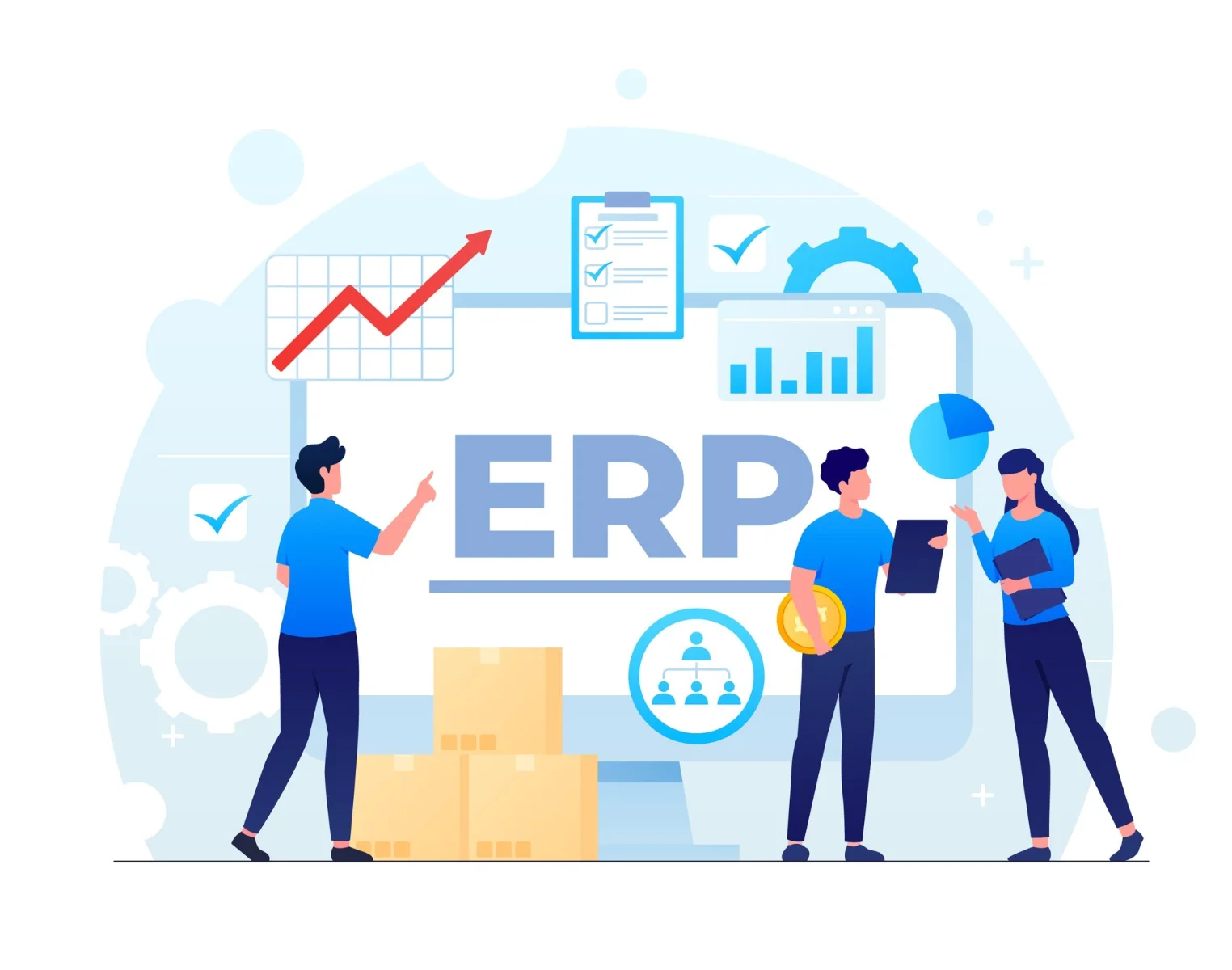
Each industry has unique business processes. Therefore, the implementation of enterprise ERP systems is usually adapted to the operational needs of each sector.
ERP for the Manufacturing Industry
The manufacturing industry requires comprehensive control over production processes, from raw material planning to finished product distribution.
The most frequently used modules include:
Production Planning
Material Requirement Planning (MRP)
Bill of Materials (BOM)
Quality Control
Inventory Management
Maintenance Management
ERP helps manufacturing companies reduce raw material waste, increase production efficiency, and ensure material availability as needed.
ERP for Distribution Companies
Distribution companies face challenges in managing inventory spread across various warehouses and branches.
ERP enables companies to:
Monitor real-time stock
Manage multi-warehouse operations
Control shipments
Optimize purchasing
Monitor sales activities
With an integrated system, distribution companies can increase service speed while maintaining inventory accuracy.
ERP for Retail
Retail businesses require synchronization between sales, inventory, purchasing, and customers.
ERP helps retail in:
Monitoring stock at each outlet
POS integration
Promotion management
Sales analysis
Customer loyalty management
Management can view the performance of all branches through a centralized dashboard.
ERP for Construction
Construction projects involve numerous vendors, materials, labor, and budgets.
ERP helps manage:
Project budgeting
Procurement
Vendor management
Project progress monitoring
Asset management
With integrated data, the risk of project cost overruns can be minimized.
ERP for Healthcare
Hospitals and clinics require accurate and fast data management.
ERP can be used for:
Patient management
Doctor scheduling
Pharmacy inventory
Billing
Finance
HR
Data integration helps improve the quality of patient services while increasing operational efficiency.
The Role of ERP Systems in Digital Transformation
Digital transformation is not merely about replacing paper documents with digital systems. Its primary goal is to create an organization that can work faster, more efficiently, and more data-driven.
A company's ERP system acts as the core of digital transformation because it can connect all departments into a single ecosystem.
Some benefits of ERP in digital transformation include:
Elimination of manual processes
Workflow automation
Cross-departmental data integration
Real-time business monitoring
Data-driven decision-making
Without ERP, many companies end up with numerous standalone applications that are difficult to integrate with each other.
Data Security in Company ERP Systems
Because ERP stores critical company data, security is a top priority in its implementation.
Role-Based Access Control
Each user has different access rights.
For example:
Warehouse staff cannot access payroll data
The HR team cannot modify financial reports
Directors have access to strategic reports
This approach helps maintain the confidentiality of company data.
Audit Trail
An audit trail automatically records all user activities.
Companies can know:
Who changed the data
When the changes were made
What data was changed
What activities the user performed
This feature is crucial for both internal and external audit requirements.
Data Encryption
Modern ERP uses encryption technology to protect sensitive data during both storage and transmission.
Backup and Disaster Recovery
A good ERP system must have automatic backup mechanisms and data recovery procedures in case of system disruptions, disasters, or cyberattacks.
KPIs That Can Be Monitored Through ERP Systems
One of the greatest benefits of ERP is its ability to provide real-time KPI dashboards.
Financial KPIs
Management can monitor:
Revenue Growth
Gross Profit Margin
Net Profit Margin
Cash Flow
Accounts Receivable
Accounts Payable
Operational KPIs
To measure operational efficiency:
Inventory Turnover
Order Fulfillment Rate
Production Efficiency
Lead Time
Capacity Utilization
Sales KPIs
The sales team can monitor:
Sales Growth
Conversion Rate
Customer Acquisition Cost
Average Order Value
Sales Pipeline
HR KPIs
The HR division can measure:
Employee Productivity
Turnover Rate
Attendance Rate
Training Effectiveness
KPI dashboards help management detect problems faster and make proactive decisions.
Differences Between ERP, CRM, WMS, and Business Intelligence Systems
Many companies still think all business systems have the same function, but each has a different focus.
ERP (Enterprise Resource Planning)
ERP integrates all company business processes.
Its primary focus:
Finance
Inventory
Purchasing
Production
HR
Sales
CRM (Customer Relationship Management)
CRM focuses on customer management and sales activities.
Its functions include:
Lead Management
Customer Database
Sales Tracking
Customer Follow Up
WMS (Warehouse Management System)
WMS focuses on warehouse operations.
Its primary functions:
Stock Management
Barcode Management
Picking & Packing
Warehouse Tracking
Business Intelligence (BI)
BI processes data into business insights.
Through BI dashboards, companies can:
Analyze business performance
View sales trends
Identify growth opportunities
Create forecasting
When these four systems are integrated, companies gain much better business visibility.
AI and the Future of Enterprise ERP Systems
The development of Artificial Intelligence (AI) is beginning to change how ERP works.
If ERP previously only functioned as a transaction recording system, now ERP can help companies perform automated predictions and analysis.
Predictive Inventory
AI can predict stock needs based on historical data, sales trends, and specific seasons.
This helps companies reduce the risk of both overstock and stockouts.
Sales Forecasting
AI can estimate future sales opportunities based on previous transaction patterns.
Management can create more accurate strategies.
Predictive Maintenance
In the manufacturing industry, AI can predict potential machine malfunctions before they occur.
This helps reduce production downtime.
Intelligent Reporting
AI-based ERP can generate automated reports complete with business insights and recommendations.
Smart Approval Workflow
The system can help prioritize approvals based on transaction value, risk, or business urgency.
AI technology is predicted to become an important part of enterprise ERP systems in the next few years.
Long-Term ERP Development Roadmap
ERP implementation does not always have to be done all at once. Many companies choose a phased approach to reduce risks and accelerate user adoption.
Phase 1: Finance and Accounting
The initial stage usually focuses on:
General Ledger
Cash Flow
Budgeting
Financial Reporting
Phase 2: Inventory and Warehouse
Includes:
Stock Management
Multi Warehouse
Barcode System
Inventory Tracking
Phase 3: Sales and CRM
Includes:
Lead Management
Customer Database
Quotation
Sales Pipeline
Phase 4: Human Resource Management
Includes:
Payroll
Attendance
Leave Management
Performance Management
Phase 5: Business Intelligence and Analytics
An advanced stage focusing on:
Executive Dashboard
KPI Monitoring
Forecasting
Data Analytics
A phased approach helps companies gain ERP benefits faster while ensuring a smoother change process across the organization.
Conclusion
An enterprise ERP system has become a crucial foundation for organizations looking to improve business efficiency, transparency, and scalability. By integrating all operational processes onto one platform, companies can reduce human error, accelerate decision-making, and create a strong foundation for long-term growth.
Investing in ERP is not merely a technology investment, but an investment in productivity, data quality, and the company's ability to compete in an increasingly competitive digital age.