Indonesia's ERP Software: Business Integration for Modern Companies
Learn the benefits of Indonesian ERP software for integrating business, improving efficiency, reducing errors, and accelerating rapid company growth.
Indonesian ERP Software: Integrated Business Solutions for Modern Enterprises
In an increasingly competitive digital age, companies can no longer rely on fragmented work systems. Many businesses still use spreadsheets, different applications for each division, and manual processes that lead to unsynchronized data and slow decision-making. This often hinders business growth, increases the risk of errors, and causes unnecessary operational costs.
This is why the use of Indonesian ERP software is increasingly becoming a primary need for modern companies. ERP (Enterprise Resource Planning) allows all business processes to run within a single integrated system, so data can be accessed in real-time, accurately, and supports better decision-making.
For companies looking to improve efficiency, accelerate growth, and build a strong digital foundation, ERP implementation is no longer just an option, but a long-term strategic investment.
What is Indonesian ERP Software?

Indonesian ERP software is a company management system that integrates various business functions into a single, centralized platform.
Unlike conventional systems where each department works using different applications, ERP unites all operational processes so that all data can be automatically interconnected.
Within a single ERP system, companies can manage:
Finance and accounting
Procurement
Sales
Inventory and warehousing
Production
Human Resources (HR)
Customer Relationship Management (CRM)
Project Management
Business Intelligence and Dashboard
When one division enters data, all related departments can immediately view that information in real-time without needing to re-enter it.
For example, when the sales team makes a new sale, the ERP system can automatically:
Reduce inventory stock
Create an invoice
Update financial reports
Display sales performance on the management dashboard
All processes run in one integrated flow.
Why Do Indonesian Companies Need ERP?
Many companies experience operational obstacles that actually stem from data integration issues.
Some common challenges include:
Data Scattered Across Many Systems
The finance team uses accounting software, the warehouse uses spreadsheets, HR uses attendance applications, while sales use separate CRM.
As a result:
Data synchronization issues
Duplicate input occurs
Reports take a long time
Increased risk of human error
ERP solves these problems by connecting all data in a single centralized database.
Difficulty Obtaining Real-Time Reports
Management needs quick reports to make decisions.
However, if data is still manually collected from various departments, the reporting process can take days or even weeks.
With ERP, reports are available in real-time through a dashboard that can be accessed anytime.
Uncontrolled Business Growth
As a company grows, the number of transactions increases significantly.
Without an integrated system, companies will experience:
Stock errors
Production delays
Financial record errors
Difficulty controlling branches
ERP allows companies to grow without excessively increasing operational complexity.
Important Modules in Indonesian ERP Software
ERP Finance and Accounting
This module helps companies manage:
General Ledger
Cash Flow
Accounts Payable
Accounts Receivable
Budgeting
Financial Reporting
Management can monitor financial conditions in real-time without waiting for manual reports.
Inventory Management
Stock management becomes more accurate because the system records:
Incoming goods
Outgoing goods
Warehouse transfers
Minimum stock
Stocktaking
Companies can reduce the risk of both overstock and stockout.
Procurement Management
The entire purchasing process can be managed, from:
Purchase Requests
Requests for Quotation
Purchase Orders
Goods Reception
Vendor Management
This helps improve cost control and purchasing transparency.
Sales Management
The sales team can monitor:
Quotations
Customer orders
Payment status
Sales targets
Sales performance analysis
All information is available in one dashboard.
Human Resource Management
Modern ERP also provides features for:
Online attendance
Payroll
Leave and permits
Performance appraisal
KPI management
HR can efficiently manage the entire employee lifecycle.
Customer Relationship Management (CRM)
CRM within ERP enables companies to:
Manage customer databases
Track leads
Monitor sales activities
Improve customer retention
Benefits of Implementing ERP Software in Indonesia

Increased Operational Efficiency
Processes previously performed manually can be automated.
Employees no longer spend time on:
Repetitive data entry
Manual reconciliation
Manual report generation
Productivity significantly increases.
Reduced Human Error
Data entry errors are a primary cause of operational issues.
ERP mitigates this risk through:
Automated validation
Approval workflows
Data integration across departments
Improved Data Accuracy
Because all data originates from a single source, companies can avoid information discrepancies between divisions.
Supported Decision-Making
The ERP dashboard allows management to view:
Sales
Financials
Inventory
Productivity
Profitability
in real-time.
Business decisions become faster and data-driven.
Business Scalability
ERP enables companies to manage:
Multiple branches
Multiple warehouses
Multiple companies
Multiple users
without increasing operational complexity.
ERP Implementation Case Study in a Distribution Company
A national distribution company has over 15 branches in various cities.
Before using ERP, they faced various problems:
Inventory data between branches was not synchronized
Sales reports were late
Transaction recording errors
Difficulty monitoring branch performance
After implementing ERP:
Achieved Results
Inventory monitoring became real-time
Report generation process reduced from several days to minutes
Data accuracy significantly increased
Management can monitor all branches through a central dashboard
The company also successfully improved operational efficiency as various administrative processes have been automated.
ERP Implementation Challenges and How to Overcome Them
Employee Resistance
System changes often cause concerns.
Solutions:
Intensive training
User assistance
Socialization of ERP benefits
Data Migration
Old data is often scattered across various systems.
Solutions:
Data audit before migration
Data cleansing
Migration testing
Inaccurate Vendor Selection
ERP must be adapted to the company's business processes.
Therefore, it is important to choose a vendor capable of developing a system according to business needs.
ERP Cloud vs. ERP On-Premise
Cloud ERP
Advantages:
Lower initial investment
Accessible from anywhere
Easier system updates
High scalability
Suitable for companies seeking rapid and flexible implementation.
On-Premise ERP
Advantages:
Full control over servers
More flexible security policies
Suitable for companies with specific regulations
The choice of model depends on the company's needs and IT strategy.
Why Choose Custom ERP over Generic ERP?
Many companies purchase off-the-shelf ERP but ultimately struggle to align the system with their business processes.
Custom ERP offers:
Features tailored to company needs
More flexible workflows
Integration with existing systems
Better scalability
Long-term development
ERP is not just software; it is the digital foundation of a company.
Therefore, the system must follow business processes, not the other way around.
The Evolution of ERP in Indonesia: From Administrative System to Strategic Corporate Platform
Initially, ERP systems were only used by large companies to manage administrative processes and record transactions. However, the development of cloud computing, API integration, artificial intelligence, and business intelligence has transformed ERP into a central hub for corporate operations.
Today, ERP is no longer solely used by large manufacturing companies, but also by:
Distributors
Retailers
E-commerce companies
Service companies
Logistics companies
Contractors
Hospitals
Educational institutions
Tech startups
Multi-branch companies
Modern ERP acts as a "single source of truth," a primary data source for all departments.
Without a centralized system, companies often encounter problems such as:
Duplicate data
Information conflicts between divisions
Difficulty conducting audits
Slow decision-making
Difficulty measuring overall business performance
ERP eliminates these obstacles by creating a single, integrated data ecosystem.
Signs a Company Needs ERP
Many companies do not realize that their operations have become too complex to manage using spreadsheets or separate applications.
Here are some indicators that a company already needs Indonesian ERP software.
Data Stored in Many Places
The finance team uses accounting software.
The warehouse team uses Excel.
The sales team uses CRM.
The HR team uses an attendance application.
When management needs a consolidated report, all data must be collected manually.
This situation often leads to:
Unsynchronized data
Duplication of work
Reporting errors
ERP eliminates this need by connecting all data within one system.
Excessively Slow Approval Processes
Purchase Requests must be printed.
Then signed.
Sent to another department.
Awaiting approval.
Then re-entered.
ERP enables digital approval workflows, allowing all processes to run faster and more transparently.
Difficulty Controlling Branches
When a company has multiple branches, the challenges that arise are:
Stock monitoring
Sales monitoring
Cash flow monitoring
Branch performance monitoring
ERP allows all branches to be connected on a single central dashboard.
Modern ERP Software Architecture
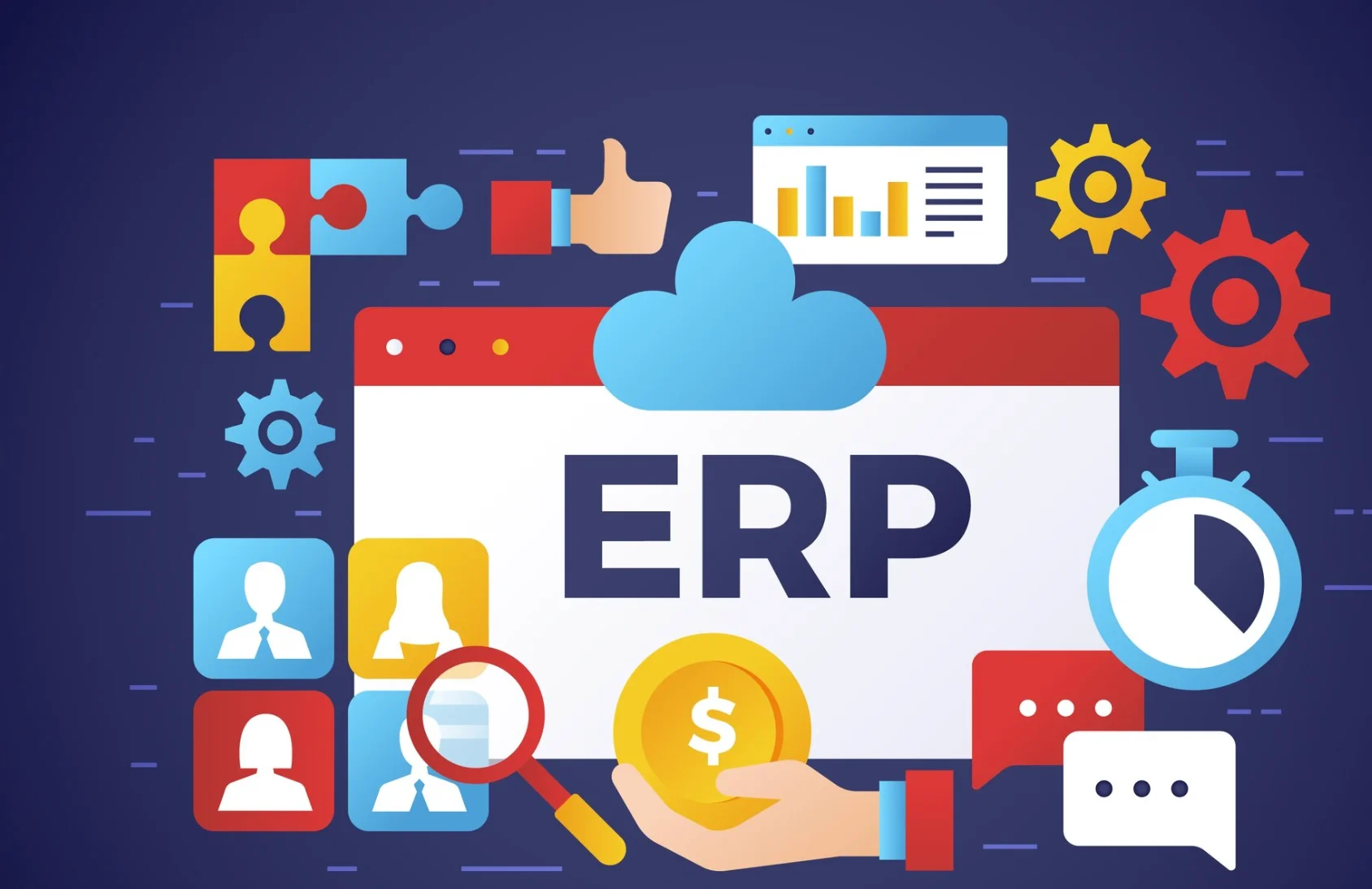
Modern ERP is built using a modular approach.
This means companies can implement modules as needed without having to activate all features at once.
Examples of ERP architecture:
Core System
Functions as the main data center.
Finance Module
Manages all financial transactions.
Inventory Module
Manages stock and warehouse.
Procurement Module
Manages purchases.
CRM Module
Manages customers.
HRIS Module
Manages Human Resources.
Business Intelligence Module
Transforms data into business insights.
All modules are interconnected through an integrated database.
ERP Integration with Other Systems
One of the advantages of modern Indonesian ERP software is its ability to perform API integration with various platforms.
Some commonly performed integrations include:
ERP and Marketplace
Connects with:
Tokopedia
Shopee
Lazada
TikTok Shop
When a sale occurs, data can directly enter the ERP.
Stock will automatically decrease.
Sales reports are updated instantly.
ERP and E-Commerce
Integration with:
WooCommerce
Shopify
Magento
Custom e-commerce
Enables synchronization of:
Products
Prices
Stock
Orders
in real-time.
ERP and Banking Systems
Facilitates:
Transaction reconciliation
Payment monitoring
Cash management
ERP and Mobile Applications
Enables field teams to perform:
Data input
Work monitoring
Approval
Reporting
directly from their smartphones.
ERP as the Foundation for Digital Transformation
Digital transformation is not just about replacing manual processes with digital ones.
Digital transformation is a comprehensive change to how a company operates.
ERP becomes the main foundation because all business processes rely on integrated data.
Without ERP, companies often experience:
Data silos
Delayed information
Duplicated work
Inaccurate reports
ERP creates a more efficient and data-driven work environment.
The Role of Business Intelligence in ERP
Many companies have large amounts of data but struggle to turn it into useful information.
Business Intelligence (BI) in ERP helps companies:
See Sales Trends
Management can see:
Best-selling products
Best sales areas
Peak sales seasons
Profitability Analysis
ERP can automatically calculate:
Product margin
Customer margin
Project margin
Executive Dashboard
Directors can view:
Revenue
Cash Flow
Profit
Inventory Value
Outstanding Receivable
all in one dashboard.
ERP and Artificial Intelligence (AI)
The latest generation of Indonesian ERP software is beginning to adopt Artificial Intelligence technology.
Some AI implementations in ERP include:
Sales Prediction
AI can predict market demand based on historical data.
Inventory Forecast
The system can estimate stock needs.
This helps reduce:
Overstock
Stockout
Smart Recommendation
AI can provide recommendations for:
Purchasing goods
Production scheduling
Sales strategies
based on operational data.
Anomaly Detection
ERP can automatically detect:
Abnormal transactions
Recording errors
Potential fraud
ERP Case Study in a Manufacturing Company
A manufacturing company has:
3 factories
12 warehouses
200 employees
Thousands of product SKUs
Before ERP implementation, the company experienced:
Problems
Stock errors up to 18%
Frequent production delays
Financial reports took 2 weeks
Difficulty calculating actual production costs
Solution
The company implemented custom ERP covering:
Production Management
Inventory Management
Procurement
Accounting
Business Intelligence
Results
Stock accuracy increased to over 98%
Financial reports available in real-time
Purchasing efficiency improved
Report preparation time significantly reduced
Production planning became more accurate
ROI of ERP Implementation
Many companies view ERP as a cost.
However, ERP is more accurately seen as an investment.
Some sources of ERP ROI include:
Reduced Human Error
Recording errors can lead to significant losses.
ERP helps minimize these risks.
Labor Efficiency
Process automation reduces repetitive administrative tasks.
Reduced Operational Costs
Through better stock control, procurement, and workflows.
Increased Productivity
Employees can focus on activities that add value to the company.
Faster Decision-Making
Real-time data allows companies to respond to market changes more quickly.
Why Choose a Local Indonesian ERP Vendor?
Many companies consider international ERPs, but local ERPs offer several advantages.
Understanding Indonesian Regulations
Such as:
Tax
VAT
Invoices
Financial reporting
Faster Support
Communication is easier due to being in the same time zone.
More Flexible Development
Local vendors are generally more adaptable to customization according to company needs.
More Efficient Implementation Costs
Companies do not need to pay high international license and consulting fees.
The Future of Indonesian ERP Software
In the next few years, ERP is expected to evolve towards:
Cloud-native ERP
AI ERP
Mobile ERP
Predictive Analytics
Hyperautomation
IoT Integration
Machine Learning Forecasting
Real-time Business Intelligence
ERP will become the central control for all company activities, from daily operations to long-term business strategy.
Companies that adopt ERP earlier will have an advantage in efficiency, speed of decision-making, and adaptability to rapidly changing market conditions.
BMS Services as a Partner for Indonesian ERP Software Development
BMS Services helps companies develop ERP software tailored to the operational needs of each business.
Our team has experience in building:
Enterprise ERP
CRM System
Inventory Management System
Warehouse Management System (WMS)
Human Resource Information System (HRIS)
Sales Force Automation (SFA)
Business Intelligence Dashboard
API and third-party system integration
Each solution is developed with a consultative approach so that the system truly supports the company's business processes, rather than just ordinary digitalization.
Through in-depth needs analysis, custom software development, and implementation support, BMS Services helps companies build an integrated digital ecosystem ready to support long-term business growth.
Conclusion
Implementing Indonesian ERP software is a strategic step for companies looking to increase efficiency, integrate all business processes, and accelerate digital transformation.
ERP helps companies eliminate data silos, reduce human error, accelerate reporting, and provide the real-time information needed for better decision-making.
Amid increasingly fierce business competition, companies that can integrate their operations through ERP will have a much stronger competitive advantage compared to companies that still rely on manual processes and separate systems.
If your company is considering ERP implementation that can be tailored to business needs, a custom ERP solution from BMS Services can be the first step to building more efficient, integrated operations, ready to face future growth challenges.